Your Technology Should Save Your Employees Time. Is It?
2026-11-04 · Chris Coulson
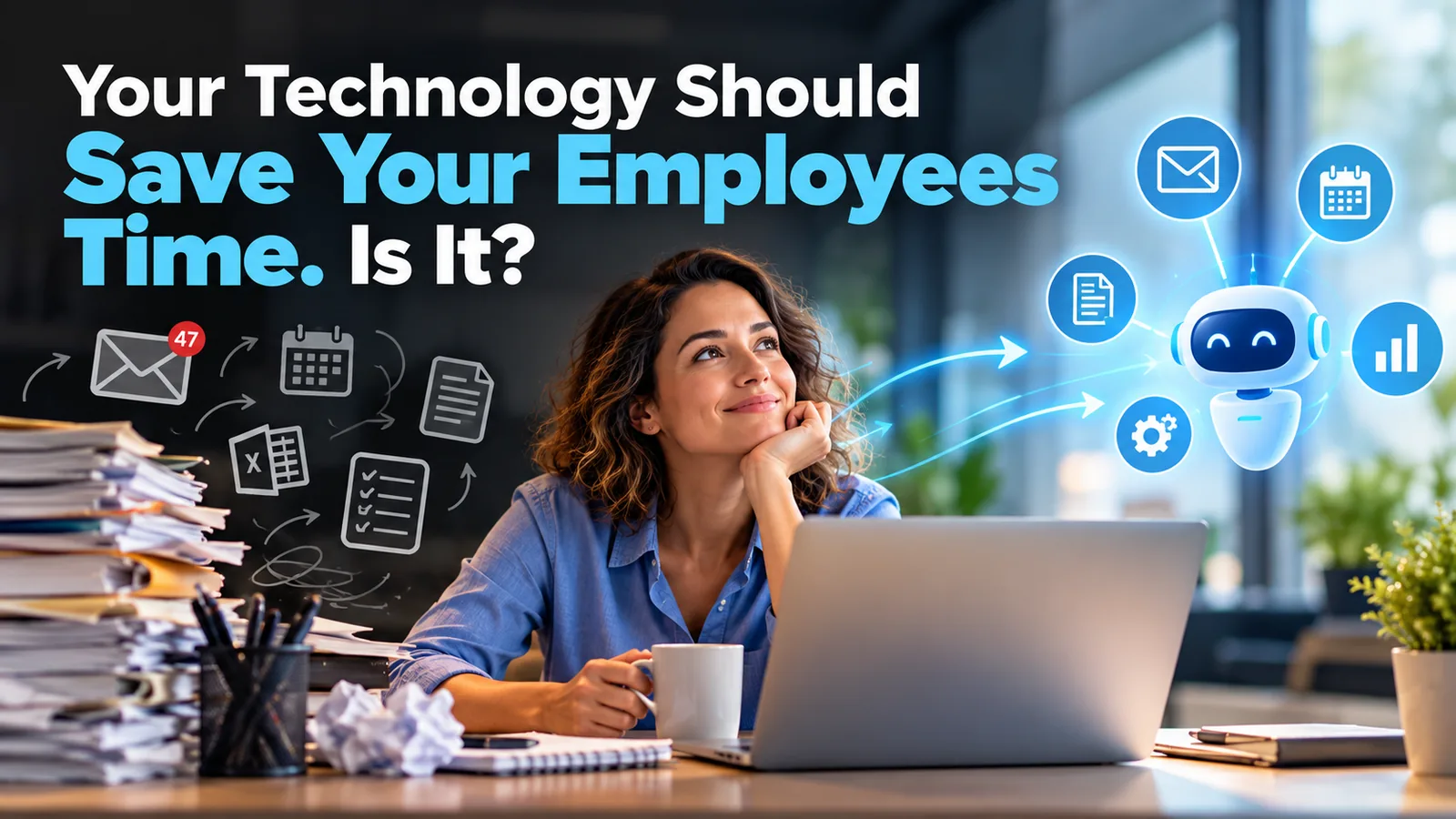
I was thinking about a pretty simple question recently:
What task takes up way more of your workday than it should?
I think if you asked that question around almost any office, you'd get some interesting answers.
Email would probably be near the top.
Scheduling meetings.
Looking for documents.
Entering information into different systems.
Following up with customers.
Putting together reports.
Maybe it's something your employees have been doing for so long that nobody even thinks of it as a problem anymore.
That's the part that interests me.
We spend a lot of money on technology that's supposed to make businesses more productive. But sometimes we get so used to the way we work that we stop asking whether the technology is actually saving anyone time.
And I think that's a question worth asking.
Start With Email
Email is probably one of the easiest examples.
I don't know many people who say, "I wish I could spend more time in my inbox."
You come in in the morning and start sorting.
Important.
Not important.
Needs an answer.
Can wait.
Someone copied you on something you probably didn't need to see.
Here's a newsletter.
Here's spam.
Here's a 14-message conversation you now have to read just to figure out what's going on.
Before you know it, you've spent a good chunk of your morning managing email instead of doing whatever you actually came to work to do.
Now imagine that happening across your entire company.
There are tools today that can help sort messages, summarize conversations, identify what needs attention and help employees respond faster.
That doesn't mean AI should answer every email for you.
It means maybe you shouldn't have to personally dig through 75 messages to figure out which five matter.
That's a very different conversation.
Pay Attention to the Little Things
One thing I've learned working with businesses is that the biggest waste of time isn't always some huge broken process.
Sometimes it's a five-minute task.
Five minutes doesn't sound like much.
But what if you do it eight times a day?
What if five employees do it?
What if you've been doing it that way for six years?
Those little tasks add up.
Maybe someone gets an email, copies information out of it and enters it into another system.
Then they update a spreadsheet.
Then they send somebody a message letting them know they updated the spreadsheet.
Nobody looks at that process and says, "This is costing us a fortune."
It's just how the job gets done.
But maybe it doesn't need to be.
Your Employees Shouldn't Be the Connection Between Your Software
This is something I see more often than I'd like.
A company may have perfectly good software, but the different systems don't talk to each other.
So who connects them?
An employee.
They take information from System A and put it into System B.
Then maybe they take something from System B and enter it into System C.
We basically turn a person into the connection between three pieces of software.
That's not a great use of someone's time.
In many cases, those systems can be connected or parts of that process can be automated.
The employee is still important. They just don't need to spend their time copying and pasting information all day.
That's what good technology should do.
It should get the repetitive stuff out of the way so people can concentrate on the things that actually require a person.
This Is Where AI Gets Interesting to Me
There's obviously a tremendous amount of conversation about AI right now.
Every week there's another tool, another feature and another promise about what AI is going to change.
I'm interested in all of that.
But when I'm talking to a business owner, I think there's a much better place to start than asking:
"How can we use AI?"
I'd ask:
"Where are your people losing time?"
That's a much more useful question.
Maybe employees spend too much time reading and sorting email.
Maybe someone prepares the same report every Friday.
Maybe your staff answers the same 10 customer questions every day.
Maybe someone spends hours scheduling appointments.
Maybe employees constantly search through documents trying to find information they know exists somewhere.
Now we have something to work with.
Maybe AI can help.
Maybe automation can help.
Maybe two systems simply need to talk to each other.
Or maybe the process itself needs to change.
I don't really care which technology solves it.
I care whether we can give that employee some of their day back.
Sometimes the Best Automation Is Eliminating the Task
This is important.
Before automating something, I always think it's worth asking why we're doing it in the first place.
If an employee enters the same information into three systems, we could figure out how to automate that.
But maybe the better question is:
Why does it need to go into three systems?
Businesses build processes over time.
Someone creates a spreadsheet because they need information for a meeting.
Someone else starts using that spreadsheet for something else.
Another step gets added.
Then another.
Five years later, there's a seven-step process and nobody remembers why Step 4 exists.
Don't automate Step 4 just because you can.
Maybe Step 4 needs to go away.
Technology should simplify the business, not help you perform unnecessary work faster.
Talk to the People Who Actually Do the Work
This is probably the most important part.
If you own or manage a business, you may not know where all these little frustrations are.
Your employees do.
They're the ones living with them every day.
Ask them.
What takes too long?
What do you do over and over again?
What do you wish you didn't have to do manually?
What makes you think, "There has to be a better way to do this"?
Then listen to the answers.
You may hear something you've never thought about.
I've always liked solving those kinds of problems because they're tangible.
If someone tells me they spend an hour every morning going through email, now we have something to look at.
If someone spends Friday afternoon building the same report every week, let's see why.
If your employees are entering the same customer information three different times, let's figure out whether they really need to.
That's a much better starting point than buying another piece of software and hoping productivity somehow improves.
Don't Measure Technology by How Much It Can Do
Technology companies love telling us how many things their products can do.
That's fine.
I think businesses should ask a different question:
What does this allow my employees to stop doing?
That's where the value can become pretty obvious.
If technology saves somebody 30 minutes every day, that's two and a half hours a week.
Over a year, that's a lot of time.
And it's not just about labor cost.
What could that employee do with those hours instead?
Talk to customers.
Follow up on opportunities.
Work on a project.
Solve a problem.
Spend more time doing the part of their job they were actually hired to do.
That's where technology starts becoming an investment instead of another expense.
Chris's Advice
Here's something I'd try.
Ask your employees this week:
What task takes up way more of your workday than it should?
Don't give them examples at first.
Just see what they say.
You may find out that someone is spending hours doing something you assumed took minutes.
You may discover three people are doing versions of the same task.
You might uncover a process that made sense 10 years ago and makes absolutely no sense today.
And you may find a perfect opportunity for AI or automation that nobody had considered.
That's how I think businesses should approach this technology.
Don't start with the tool.
Start with the problem.
Find something that's wasting your employees' time and see if there's a better way to do it.
Because at the end of the day, I don't think the goal should be to put more technology in front of people.
The goal should be to use technology to give people some of their time back.
And if your technology isn't doing that, I'd start asking why.